
AI-powered test case generation can cut manual test authoring time dramatically—but it doesn’t change who owns the QA strategy, the traceability, or the audit trail. QAConnector’s TestGen AI is built to do the heavy lifting while keeping QA leaders accountable for what matters: coverage, compliance, and release confidence.

New to AI test generation? See how TestGen AI works before your next sprint planning.
The AI Testing Moment—What Just Changed for QA Teams
Most QA practitioners know the drill: a new sprint starts, the requirements land, and somewhere in the next 48 hours you’re expected to have a test suite ready to go. For years, that meant manual authoring—parsing each requirement, mapping positive cases, building negative scenarios, doing it all again when the spec changed overnight.
AI test case generation changes that workflow in a meaningful way. Tools like QAConnector’s TestGen AI can take a requirements document, a user story, or a prompt and return structured positive and negative test cases in under two minutes. [VERIFY time benchmark with product team] The generation step—which used to be the bottleneck—moves off your plate.
What doesn’t move off your plate: the judgment about which requirements need deep coverage. The call on which defects block a release. The audit trail that proves your QA program was sound when someone asks. Those still belong to you.
This post is about that line—and how QAConnector is built to make sure AI does the work it’s good at without creating the accountability gaps that sink QA programs in audits and post-incident reviews.
What TestGen AI Actually Does—and How Fast
TestGen AI is QAConnector’s built-in AI test generation feature. It is not a bolt-on; it’s part of the QA management platform that connects your test cases to requirements, execution results, and defects in a single audit trail.
The generation workflow looks like this:
- Input your requirement — paste a user story, upload a requirements document, or write a plain-language prompt describing what the feature should do
- TestGen AI generates — within minutes, the feature produces a set of positive test cases (happy-path coverage) and negative test cases (edge cases, error conditions, boundary inputs)
- Practitioner reviews — AI-generated cases are not auto-promoted to execution; QA practitioners review, edit, and approve them before they enter the test plan
- Cases link to requirements — approved cases connect directly to their source requirement in QAConnector’s traceability framework, so every test is accounted for
- Execution and reporting — cases run, results are captured in Real-Time Reporting, and the full chain (requirement → test case → execution → defect) is available on demand for any auditor, executive, or stakeholder who needs it
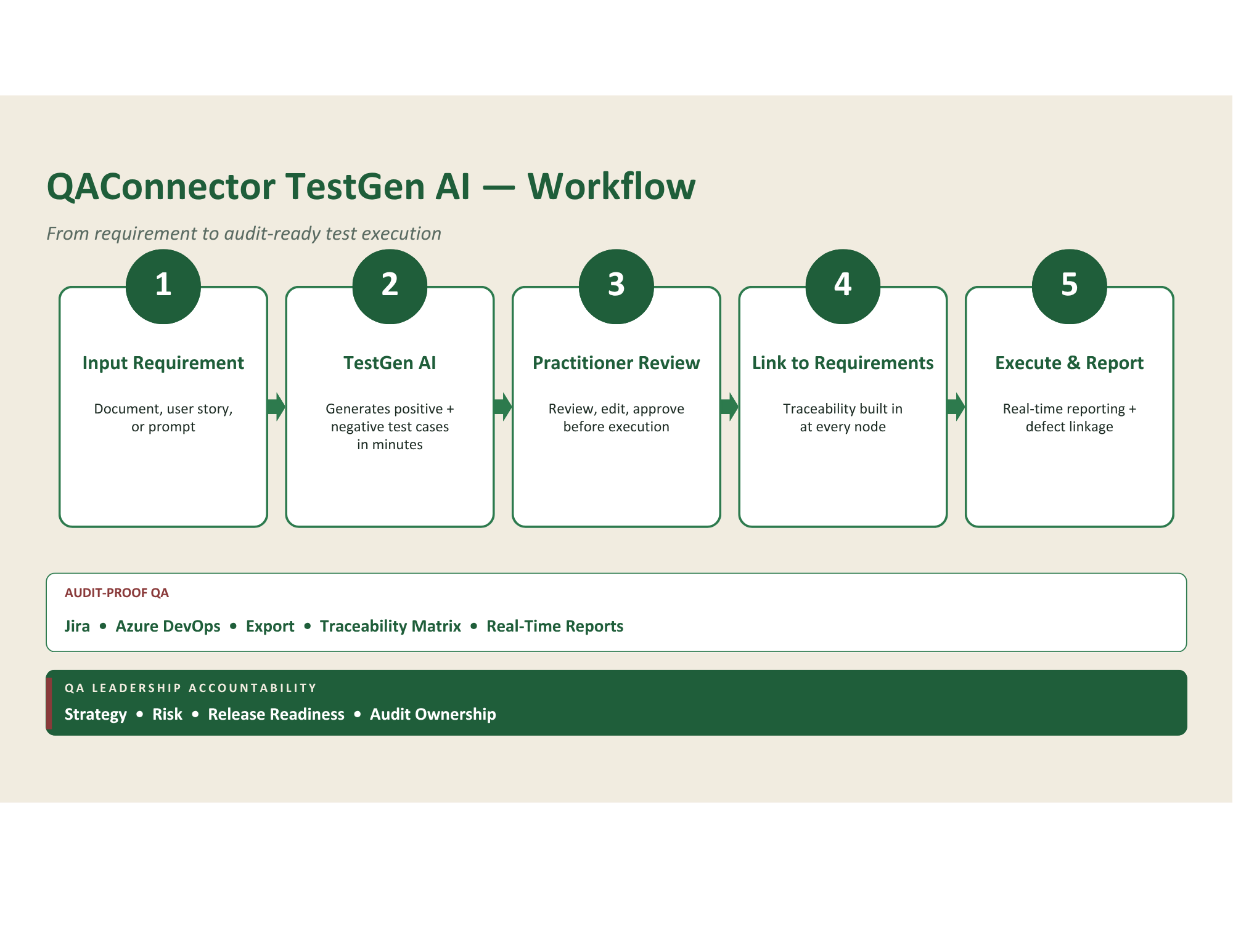
The integration with Jira and Azure DevOps means TestGen AI fits into the stack your team already runs—not as a separate tool to manage, but as the generation layer inside the platform where your test management already lives.
What AI Can’t Generate—The QA Leadership Gap
Here’s the part the productivity pitch for AI testing usually skips.
QA leadership accountability is the human ownership of test strategy decisions, traceability completeness, and audit readiness that no AI model can inherit. It is what makes AI-generated test coverage enterprise-safe.
AI can generate test cases. It cannot:
- Decide which requirements are highest-risk and deserve deeper coverage
- Make the release-readiness call when two critical defects are still open and the business is pushing
- Own the audit trail in the way that means a specific human is accountable for what it says
- Communicate quality outcomes to stakeholders who are deciding whether to trust the release
- Answer the question “who owns this?” when something goes wrong after a deployment
Those decisions require a QA leader. They always have. AI test generation makes the execution faster—it doesn’t dissolve the leadership layer that gives the execution its authority.
The QA teams that get into trouble with AI-assisted testing are rarely the ones who moved too slowly. They’re the ones who let AI-generated test coverage stand in for QA strategy—and found out at the worst possible moment that a list of test cases isn’t the same as a defensible quality program.
The Traceability Imperative—Why AI-Generated Tests Need a Platform
This is where the platform choice matters.
AI-generated test cases sitting in a spreadsheet or a standalone document are compliance exposure. They were generated by a model, edited by a practitioner, executed by an automation runner—and there is no thread connecting those steps to the requirements they were supposed to cover or the defects they caught along the way.
An auditor asks: “Show me that your QA process covered Requirement 47.” If the answer is “we have a test case doc and some CI logs,” that’s a problem.
QAConnector’s Audit-Proof QA feature exists specifically for this. Every test case—AI-generated or manually authored—is connected to its requirement from the moment it enters the platform. Execution results link back to the test case. Defects link to both. The chain is unbroken, version-controlled, and exportable in the format your auditor needs.
| AI-Generated Testing Risk | QAConnector Solution |
| Test cases exist, but don’t connect to requirements | Every case links to its requirement on creation |
| No audit trail from requirement to execution | Full traceability: requirement → test case → result → defect |
| AI output changes without version history | Version-controlled test cases in QAConnector |
| CIO can’t see coverage status in real time | Real-Time Reporting — visible to anyone with role-based access |
| Audit review requires manual assembly of evidence | Exportable compliance reports on demand |
For the QA practitioners reading this: the table above is what keeps AI-generated tests from becoming a liability in the next audit. For the CIOs reading this: it’s also what makes the QA investment legible — you can see what’s covered, what’s not, and who owns it.
This is also what connects the QAConnector platform to the broader conversation about leadership authenticity in AI-assisted environments—a topic the leadership community has been wrestling with directly. If you’re interested in the executive angle on AI and authentic leadership, CelticQA’s companion piece on quality leadership in the AI era covers that ground from the organizational side.
Ready to see how QAConnector connects TestGen AI to your traceability framework? Download the QAConnector Quick-Start Checklist — and see the integration steps for your stack.
A Workflow Built for QA Leaders, Not Just QA Teams
QAConnector was built by CelticQA Solutions—a QA services company with 20+ years of experience embedding quality leadership inside engineering teams. That history shows in the platform design: it’s not a test case management tool with AI added. It’s a QA management platform where AI-generated test cases, real-time execution visibility, and audit-proof traceability live together in one source of truth.
For QA practitioners: TestGen AI cuts the manual authoring bottleneck without asking you to give up the review step. You stay in the loop. The platform stays clean.
For CIOs and QA leadership: the Microsoft Azure foundation gives you enterprise-grade security and compliance posture. Real-Time Reporting makes quality status visible without a status-meeting. Audit-Proof QA means the next compliance review doesn’t require a fire drill to assemble evidence.
Next-Generation QA Management isn’t a positioning claim—it’s TestGen AI generating the test cases, Real-Time Reporting surfacing the results, and Audit-Proof QA making the entire chain defensible. All in the same platform. All connected.
Frequently Asked Questions
What is AI test case generation? AI test case generation uses a language model to produce positive and negative test cases from a requirements document, user story, or prompt—without manual test authoring. QAConnector’s TestGen AI generates structured test cases in minutes, connecting them directly to your requirements in the platform’s traceability framework. [VERIFY time claim with product team]
Can AI replace QA testers? AI test generation reduces manual test authoring time significantly—but it doesn’t replace QA practitioners. QA teams still own test strategy, risk prioritization, execution judgment, and review of AI-generated cases for coverage gaps. AI makes the routine faster; it doesn’t replace the expertise that makes the strategy sound.
How does AI test generation work with Jira and Azure DevOps? QAConnector’s TestGen AI integrates with Jira and Azure DevOps, connecting AI-generated test cases to your existing requirements and project management workflow from day one. Test cases—AI-generated or manual—are tracked in one audit trail inside QAConnector, alongside your existing integrations.
Is AI-generated testing audit-proof? AI-generated test cases are only as audit-proof as the platform that manages them. QAConnector’s Audit-Proof QA feature ensures every AI-generated case is traceable to its requirement, its execution result, and any associated defect—exportable in the format your auditor needs, on demand.
What does QA leadership need to own when using AI testing tools? QA leaders own the strategy (which requirements get coverage and at what depth), the risk calls (which defects block release), and the accountability (the human who can answer for the quality outcome). AI assists the execution; QA leaders own the outcome. QAConnector is built so that distinction stays clear.
What makes QAConnector different from other AI test generation tools? Most AI test generation tools generate cases and stop there. QAConnector’s TestGen AI is built into a full QA management platform—so AI-generated cases connect to requirements, execution results, and defects in a single, version-controlled audit trail. That’s what makes AI-assisted testing enterprise-ready, not just fast.
Test Better. Lead Clearly.
AI-generated test case generation is a genuine step forward for QA teams—faster coverage, less manual bottleneck, more capacity for the judgment work that actually needs human attention. QAConnector’s TestGen AI is built to deliver that without creating the compliance gaps that catch teams off guard when it matters most.
The test cases are generated. The traceability is built in. The leadership accountability is still yours.
Schedule a QAConnector demo — and see how TestGen AI connects to your traceability framework from day one.
Recent Comments