
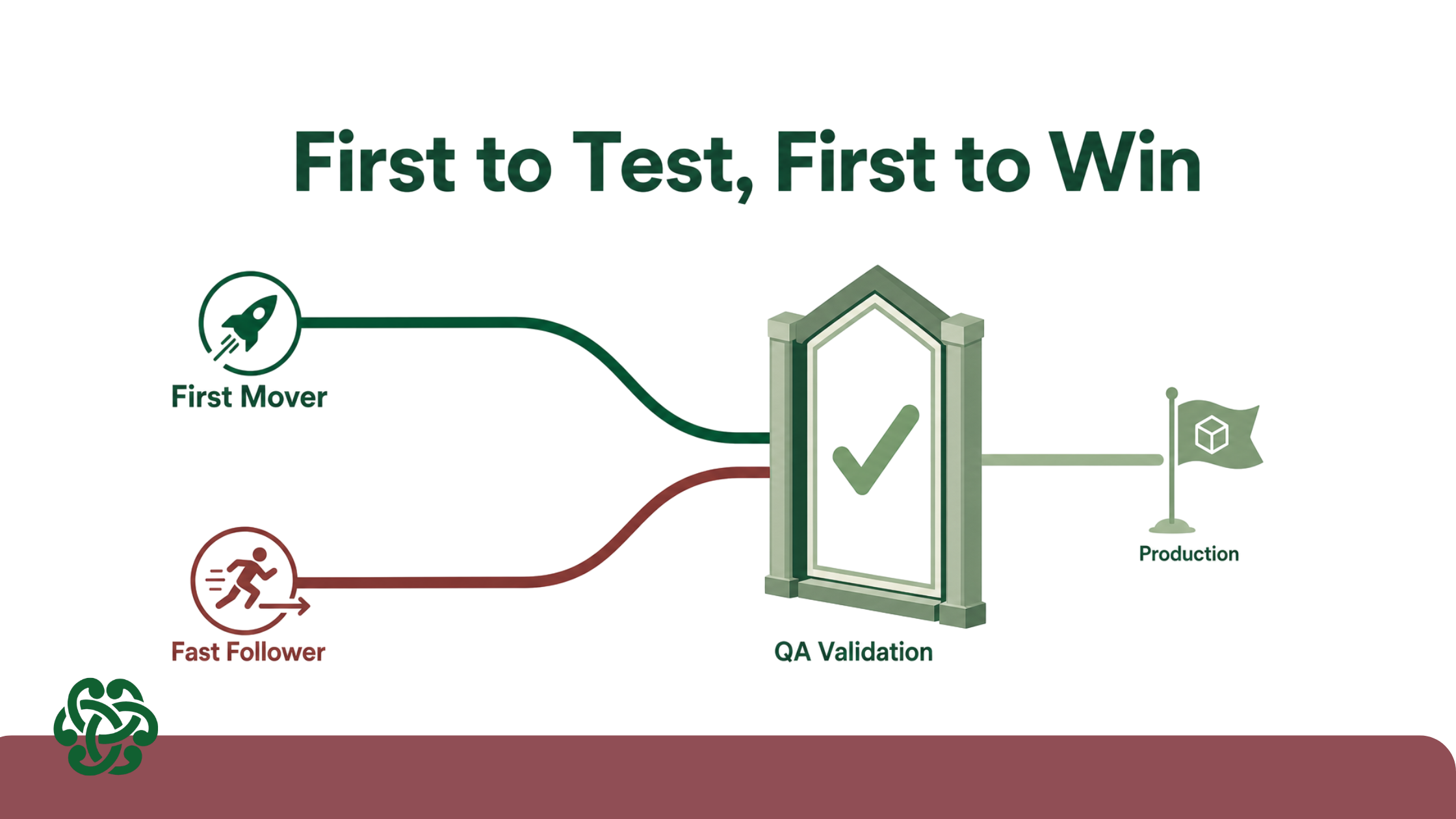
Whether your organization moves first or follows fast, every technology rollout has one thing in common: the QA team absorbs the risk. The business sets the adoption pace. The QA management platform determines whether that pace is achievable without introducing unacceptable risk into existing systems and delivery cycles. Organizations that invest in the right platform before a major technology adoption navigate rollouts faster, with fewer production incidents, and with the audit trail to prove it.
Why QA Teams Are Always at the Center of Technology Adoption Risk
When a new technology arrives a new ERP layer, a cloud migration, an AI-enabled workflow, the immediate pressure lands on QA. Integration points need coverage. Existing regression suites need to be extended or rebuilt. Test data needs to reflect the new system’s behavior. Stakeholders are watching dashboards that may not yet be configured for the new environment.
That pressure is where most technology adoptions slow down or stumble. Not because the technology is wrong, but because the QA infrastructure wasn’t ready to absorb it at adoption speed.
The question isn’t whether your team can test the new technology. Of course they can. The question is whether they can test it quickly enough, with enough coverage, and with enough traceability to give leadership the confidence to move forward on schedule.
That’s the QA management problem. And it’s solvable with the right platform.
See how QAConnector brings test planning, execution, automation, and reporting together in one platform for teams navigating technology adoption.
What the first 30 days of adoption actually look like for QA
QA engineers and QA managers don’t experience technology adoption the way the announcement decks describe it. The deck says “seamless integration.” The QA team inherits the integration test matrix.
Here’s what the first 30 days typically look like from the QA side:
- A new set of requirements that may or may not be fully documented
- Integration points with existing systems that may or may not have test coverage
- A compressed timeline because “we’re already behind schedule”
- A regression suite that wasn’t built to cover what’s changing
- A leadership team asking for a confidence number they can take to the board
That last one is where QA management platforms either earn their keep or fall short. If your test management is happening in spreadsheets, or across disconnected tools with no unified reporting, you can’t produce that number reliably. You can estimate it. You can hope it. But you can’t show the traceability from requirement to test case to result to defect resolution that makes it defensible.
What Your QA Management Platform Must Do When New Technology Arrives
Not every QA management platform is built for the pace, and coverage demands of technology adoption. Here’s what the right one does.
Generates test cases from requirements at AI speed
The slowest part of technology adoption from a QA perspective is test case creation. When requirements arrive in batches, test case authoring becomes the bottleneck that delays coverage and delays the adoption timeline.
QAConnector’s TestGen AI changes this. Import the requirements document; upload a PDF, paste text, write a prompt and TestGen AI generates positive and negative test cases in minutes. Not hours. Not days. Minutes.
For a technology adoption that involves dozens of new integration points and hundreds of new requirements, that speed difference isn’t incremental. It’s what determines whether QA can keep pace with the adoption timeline or fall permanently behind it.
Gives every stakeholder a real-time view
Technology adoption doesn’t fail in the test environment, it fails in the communication gap between QA and leadership. When QA is running tests in a tool that doesn’t surface real-time data to the rest of the organization, leadership makes decisions without current information. That’s where adoption risk turns into production incidents.
QAConnector’s Real-Time Reporting eliminates that gap. Test progress, defect trends, coverage status visible to QA leads, engineering managers, and CIOs without waiting for a status email or a weekly standup. Every stakeholder sees the same dashboard, derived from the same underlying data.
For the CIO who needs a confidence number before approving go-live: that number comes from Real-Time Reporting, backed by full traceability.
Integrates with your existing stack without replacing it
Technology adoption already requires your team to learn something new. The last thing they need is a QA management platform that requires abandoning the tools they already know.
QAConnector’s Test Stack Integration connects with Jira, Azure DevOps, and Ranorex so existing project tracking and automation workflows stay intact while QAConnector provides the test management layer that ties them together. Your team doesn’t choose between their current toolchain and a better QA management platform. They get both.
Creates an audit trail from day one
For organizations in regulated industries; financial services, healthcare, manufacturing, technology adoption isn’t just a technical event. It’s a compliance event. New integrations need to be validated against regulatory frameworks. Changes need to be logged, traceable, and defensible.
QAConnector’s Audit-Proof QA capability creates that trail automatically. Every test logged. Every result traceable to a requirement. Every change versioned and time-stamped. Built on Microsoft Azure for enterprise-grade security, reliability, and compliance.
When the auditor asks what was tested and how it was validated the answer is already documented.
First Mover or Fast Follower: The QA Platform That Handles Both
The first-mover organization is moving fast, with immature vendor documentation and integration patterns that haven’t been tested at scale. TestGen AI lets the QA team build broad coverage quickly even when requirements are still evolving.
The fast-follower organization is under pressure to move faster than the first mover did, absorbing institutional learning from the market and compressing it into a tighter adoption window. Real-Time Reporting gives leadership the confidence data to push the adoption timeline forward without guessing.
Both scenarios require the same thing: a QA management platform that can absorb adoption pace without creating its own bottleneck.
For a deeper look at how quality readiness shapes the first-mover vs. fast-follower decision at the organizational level and what to assess before your next adoption cycle — see First Mover or Fast Follower? How Quality Readiness Determines Who Wins with New Technology on the CelticQA blog.
For QA Leaders Making the Case for Better Tooling
If you’re a QA manager or QA lead navigating a technology adoption, you already know your platform matters. The challenge is often making that case to a CIO or VP of Engineering who’s focused on the adoption timeline, not the tooling decision.
Here’s the business case in one sentence: the right QA management platform is what allows adoption to move at business speed, not QA speed.
When test case generation takes days instead of hours, the bottleneck is visible. When reporting requires manual aggregation, the CIO doesn’t have the confidence data they need. When audit trails aren’t built in, compliance risk accumulates.
QAConnector addresses all three for QA practitioners and for the leaders who sign off on technology investment. Schedule a demo and show your organization what faster, safer technology adoption looks like with the right QA management platform behind it.
First to Test, First to Win
Technology adoption moves at business speed. QA doesn’t have to be the constraint that slows it down — but it is, when the platform isn’t right.
QAConnector brings test planning, AI-powered test generation, Real-Time Reporting, and Audit-Proof QA together in a single QA management platform built for the demands of modern software delivery — including the demands of adopting what’s next.
Schedule a QAConnector demo and see how your team can move faster on your next technology adoption without adding risk.
FAQ: QA Management for Technology Adoption
What is a QA management platform?
A QA management platform is a unified system for test planning, test case management, execution tracking, defect management, and reporting. Unlike point tools separate test case repositories, standalone defect trackers, disconnected automation dashboards a QA management platform connects these into a single source of truth for the QA team and the stakeholders who depend on their output.
How does AI help QA teams during technology adoption?
AI-powered test generation, like QAConnector’s TestGen AI, significantly reduces the time required to build test coverage for new functionality. Instead of QA engineers manually authoring test cases from requirements documents, TestGen AI generates positive and negative test cases in minutes allowing teams to build coverage at the pace of adoption rather than behind it.
What is TestGen AI?
TestGen AI is QAConnector’s built-in AI feature for rapid test case generation. It accepts requirements in multiple formats, uploaded documents, pasted text, or written prompts and generates positive and negative test cases automatically. Designed for real-world QA workflows: flexible inputs, instant results, and output that QA engineers can review and deploy immediately.
What is Audit-Proof QA?
udit-Proof QA is QAConnector’s approach to traceability and compliance documentation. Every test logged, every result recorded, every requirement validated; stored in a structured, tamper-evident format on Microsoft Azure. For organizations in regulated industries, Audit-Proof QA means the compliance documentation for a technology adoption is built into the QA workflow, not assembled after the fact.
How does QAConnector integrate with existing tools?
QAConnector’s Test Stack Integration connects with Jira (project and defect tracking), Azure DevOps (CI/CD and work management), and Ranorex (test automation). Teams keep their existing workflows; QAConnector adds the test management and reporting layer that connects them into a unified view.
Who is QAConnector built for?
QAConnector is built for two audiences: QA practitioners (engineers, managers, leads, SDETs) who need faster test case creation, better coverage tracking, and automation integration; and engineering and technology leaders (CIOs, CTOs, VPs of Engineering) who need defensible quality reporting and audit readiness for their technology initiatives.
Recent Comments