

Release readiness reporting is the practice of showing, with traceable evidence, that every quality gate passed before a build ships. A strong report connects requirements, test cases, results, and open defects in one view, so QA teams can answer “are we ready?” in minutes and CIOs can sign off with confidence.
The 4 p.m. go/no-go scramble
It’s the afternoon before a release. Someone in the go/no-go meeting asks the question every QA manager knows is coming: “Are we good to ship?”
The tests ran. The gates passed, mostly. But proving it means pulling results from the automation tool, linking them to stories in Jira, checking defect status in Azure DevOps, and pasting it all into a slide that’s out of date before the meeting starts.
That’s the problem release readiness reporting solves. This post covers what goes in a solid report, why quality gates break down without traceable evidence, and how QAConnector turns test results into a go/no-go decision.
What is release readiness reporting?
Release readiness reporting is a structured, evidence-based summary showing that a build has met its exit criteria: requirements covered, tests executed, gates passed, and open defects assessed for risk. Unlike a test summary, it’s built for a decision. It tells stakeholders whether to ship, not just what ran.
What goes in a release readiness report?
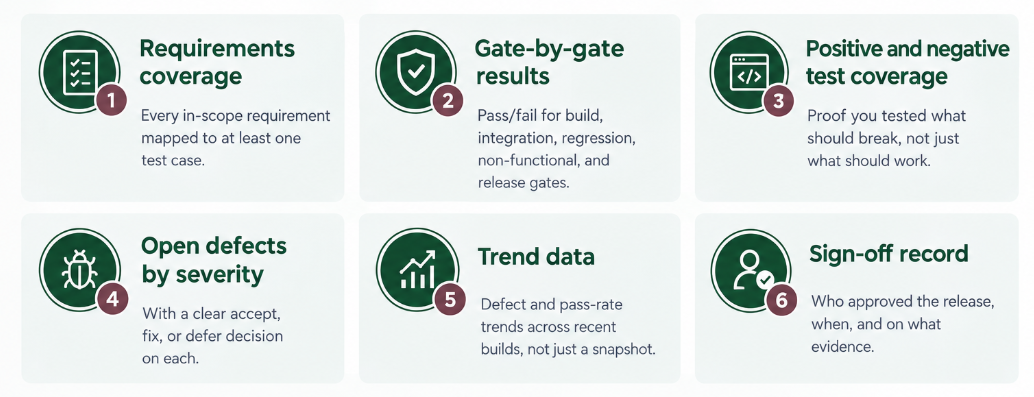
- Requirements coverage: every in-scope requirement mapped to at least one test case.
- Gate-by-gate results: pass/fail for build, integration, regression, non-functional, and release gates.
- Positive and negative test coverage: proof you tested what should break, not just what should work.
- Open defects by severity: with a clear accept, fix, or defer decision on each.
- Trend data: defect and pass-rate trends across recent builds, not just a snapshot.
- Sign-off record: who approved the release, when, and on what evidence.
If any of these lives in a spreadsheet someone updates by hand, it’s the weakest link in your release.
Why do quality gates fail without traceable evidence?
Our parent company, CelticQA Solutions, recently wrote about the QA automation gates that prevent production escapes. It’s a strong framework. But a gate is only as trustworthy as the evidence behind it.
Here’s where it breaks down in practice. A regression gate passes, but nobody can show which requirements those tests covered. A negative path was never written because the SME who knew the edge cases was unavailable. A results export is three builds old. On paper, every gate is green. In reality, the release decision rests on assumptions.
When auditors or a CIO ask why a gate passed, “the dashboard was green” isn’t an answer. Traceability is.
How QAConnector turns test results into a go/no-go decision
QAConnector is a QA management platform built by QA professionals to bring test planning, execution, automation, and reporting together. Here’s how each piece feeds release readiness.
TestGen AI closes coverage gaps before the gate
Coverage gaps often start upstream, when test authoring waits on stakeholders or SMEs. TestGen AI generates positive and negative test cases in minutes from a requirement document, an import, or a prompt. That means the edge cases most likely to escape get written before the regression gate runs, not after an incident.
Real-Time Reporting shows gate status as it happens
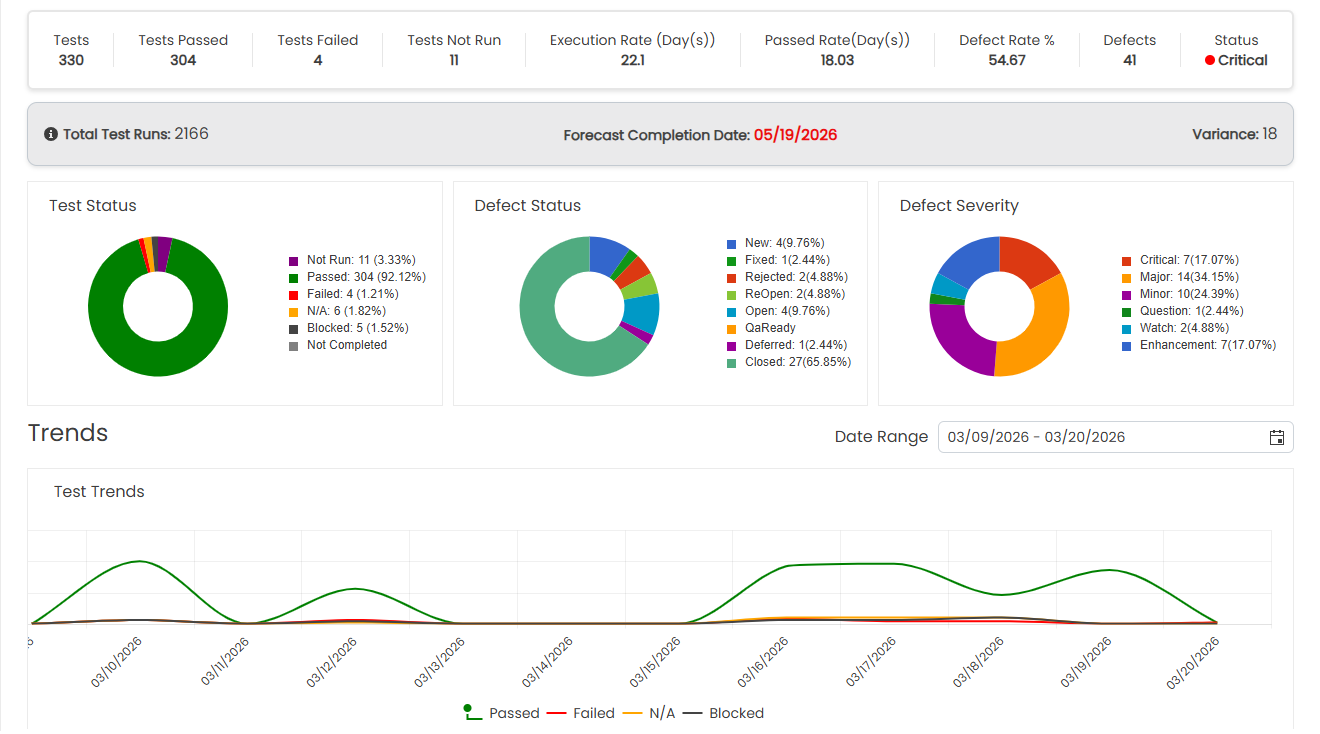
Real-Time Reporting gives you live visibility into test progress, defects, and trends, with no delays and no filters. When someone asks “are we ready?”, you open the view instead of building a slide.
Audit-Proof QA keeps the evidence intact
Audit-Proof QA logs every test and makes every result traceable back to its requirement. You get complete, structured records of what was tested, by whom, and with what result, ready for SOX, NIST, or ISO review.
Test Stack Integration pulls everything into one view
With Test Stack Integration, QAConnector connects to Jira, Azure DevOps, and automation tools, so results, stories, and defects sit in one source of truth instead of four tabs.
Want to see the reporting layer in detail? Explore Real-Time Reporting.
Spreadsheet reporting vs. platform reporting
| Spreadsheet / slide reporting | QAConnector | |
| Freshness | Stale by the meeting | Real-time |
| Traceability | Manual links, often missing | Requirement → test → result → defect |
| Negative coverage | Depends on who wrote the tests | TestGen AI generates both |
| Audit trail | Reconstructed after the fact | Logged by default |
| Prep time | Hours before every release [VERIFY: typical prep time if a source is available] | Open the view |
The CIO view: what the closer needs to see
The QA manager runs the go/no-go meeting. The CIO owns the risk if the release goes wrong. A release readiness report built in QAConnector gives the closer what they need on one screen:
- A clear go/no-go status, backed by gate-by-gate evidence.
- Defect-risk exposure in business terms: what’s open, how severe, and what’s been accepted.
- Audit readiness: a traceable record for SOX, NIST, and ISO reviews.
- Platform trust: QAConnector is built on Microsoft Azure for enterprise-grade security, reliability, and compliance.
Test Better = Save Money + Time. When the evidence is already assembled, release decisions get faster and less risky.
FAQ:
What is a release readiness report?
A release readiness report is an evidence-based summary showing whether a build meets its exit criteria. It covers requirements coverage, test results by quality gate, open defects and their risk, and a sign-off record. Its purpose is to support a go/no-go decision, not just to list what ran.
Who signs off on release readiness?
Typically the QA manager or QA lead recommends go or no-go, and a release owner, Head of Quality, or CIO gives final approval. In regulated industries, compliance or internal audit may also review the evidence. Clear, traceable reporting makes every one of those approvals faster.
How do you prove test coverage before release?
Map every in-scope requirement to at least one test case, include both positive and negative scenarios, and link each test to its latest result. A QA management platform like QAConnector maintains that traceability automatically, so coverage can be shown in a single view instead of rebuilt by hand.
What is the difference between a test summary report and a release readiness report?
A test summary report describes what was tested and the results. A release readiness report goes further: it ties those results to requirements and exit criteria, assesses open defect risk, and records the release decision. One reports activity. The other supports a decision.
Can AI-generated test cases be trusted for release decisions
Yes, when they’re reviewed and traceable. TestGen AI generates positive and negative test cases from your requirements, and QA practitioners review and refine them in QAConnector. Each test stays linked to its requirement and results, so AI-generated test cases carry the same audit trail as hand-written ones.
How does release readiness reporting support audits?
Auditors want proof that requirements were tested and that releases were approved on evidence. Audit-Proof QA in QAConnector logs every test, result, and approval in a structured, traceable record. That turns audit preparation from a reconstruction exercise into a report you can pull on demand.
Conclusion
Quality gates stop defects. Release readiness reporting proves they did. When requirements, tests, results, and defects live in one traceable view, QA teams can answer “are we ready?” with confidence, and CIOs can sign off knowing the evidence will hold up.
Ready to replace the go/no-go scramble with a report that builds itself? Schedule a demo of QAConnector, the QA management platform built by QA professionals at CelticQA Solutions.
Recent Comments