
AI testing isn’t a coverage problem — it’s an evidence problem. AI-generated test cases is half the work; capturing who tested what, against which expected behavior, with what model version, is the half that earns audit sign-off. TestGen AI does both in one workflow.
Why AI test coverage alone doesn’t earn auditor trust
You can run a thousand AI-generated test cases scenarios. If you can’t show, for any one of them, the input, the model version that produced the output, the reviewer who validated it, and the decision they made — coverage doesn’t matter. The auditor isn’t asking how many tests. They’re asking show me one.
This is where most AI test stacks break. The tools generate tests. The reviewers approve in chat. The evidence lives in screenshots, exports, and someone’s memory. When the audit lands, the team spends two weeks reconstructing what they did.
QAConnector was built by QA practitioners who’ve sat through that audit. The platform produces the evidence as the test runs — not after.
Watch a 2-minute walkthrough of TestGen AI →
How TestGen AI generates AI-system test cases
TestGen AI is the test-case-generation engine inside QAConnector. For AI systems, the workflow looks like this:
- Input the requirement, prompt template, or document. TestGen AI accepts requirements docs, structured prompts, or example datasets. No special prep needed.
- Generate positive scenarios. Cases that exercise the AI behavior the way it’s intended — happy paths, expected ranges.
- Generate negative and adversarial scenarios. Cases that probe failure modes — edge inputs, prompt injection patterns drawn from the OWASP Top 10 for LLM Applications, out-of-distribution data, role-confusion attempts.
- Tag each case against the requirement. Every generated case maps back to the requirement that produced it. Coverage is measured against requirements, not against test count.
- Output as structured test cases. Each case is a stored object with input, expected behavior band, version metadata, and reviewer assignment.
The teams running this workflow typically cut manual test authoring effort by up to 80%, especially in the first round when the surface area to cover is largest.
From AI-Generated test cases to audit trail in one workflow
Audit-Proof QA is QAConnector’s pattern for end-to-end traceability — input, model version, prompt, output, reviewer, decision, and version history captured automatically as the test runs.
The structure looks like this:
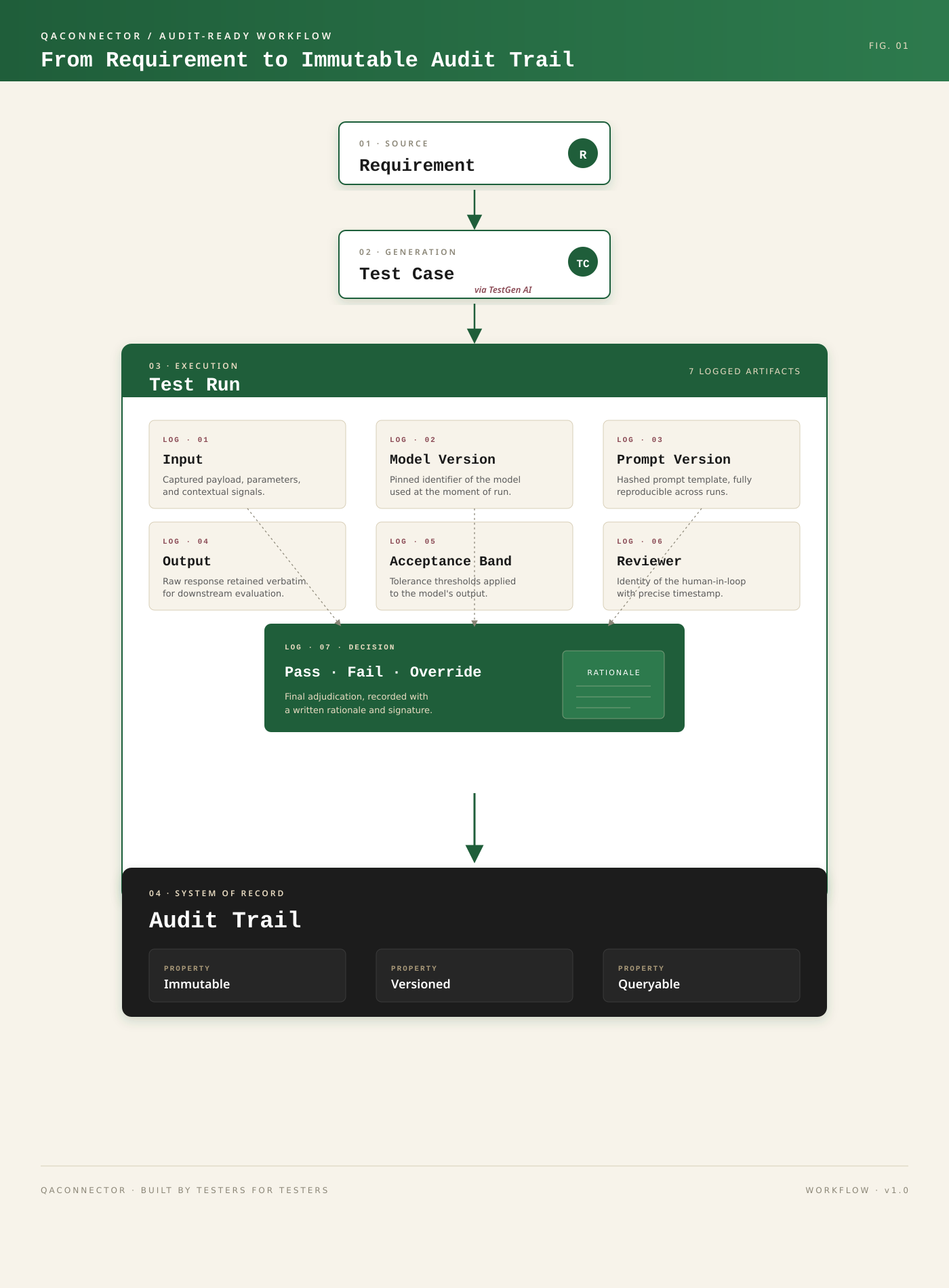
The trail isn’t a report you generate at audit time. It’s a structure that exists as soon as the test runs. When the auditor or executive asks “how do you know it works,” the answer is a query, not a recovery operation.
What audit-ready AI testing looks like in practice
When auditors ask about an AI feature, they want five artifacts. Audit-Proof QA produces all five automatically:
- Coverage map — every requirement, what it was tested against, the gap (if any).
- Versioned evidence — every test result tied to a specific model version and prompt version.
- Reviewer log — who validated each result, when, with what rationale.
- Override trail — every time someone marked a fail as acceptable, with the documented reason.
- Drift baselines — how the system performed at launch vs. how it performs now.
These aren’t reports the team builds at audit time. They’re the operational artifacts the team works inside daily — the audit case is just a query against them.
For organizations operating AI in regulated contexts, this structure aligns with the documentation expectations of ISO/IEC 42001 (AI management systems) and the NIST AI Risk Management Framework. Audit-Proof QA produces the artifacts those frameworks expect — without a separate compliance project.
Built on Microsoft Azure for the security floor
QAConnector runs on Microsoft Azure. That gives AI testing data — including model outputs, prompts, and reviewer decisions, which are often sensitive — the security and compliance baseline of Azure: role-based access controls, encrypted data handling, region-aware storage, and the underlying compliance posture Azure carries (SOC 2, ISO 27001, FedRAMP, and others depending on tenant configuration).
For regulated industries, the Azure foundation is what lets QAConnector show up in a vendor security review without surprises.
Frequently asked questions
What is AI test case generation? AI test case generation uses an AI model to produce test cases automatically from requirements, prompts, or documents. Quality platforms generate both positive cases (expected behavior) and negative or adversarial cases (edge conditions, prompt injection, drift triggers) — typically reducing manual authoring effort by up to 80%.
What makes AI testing “audit-ready”? Audit-ready AI testing means every test result is traceable to its inputs, model version, reviewer, and decision — automatically. Not retrospectively reconstructed. Audit-Proof QA captures this trail as the test runs, so the evidence is there before anyone asks for it.
How does TestGen AI handle non-deterministic AI behavior? TestGen AI generates scenarios against golden datasets and adversarial inputs, scores results against defined acceptance bands, and logs both passing and failing answers with full context. The result is structured evidence of behavior, not a single pass/fail.
What compliance frameworks does QAConnector support for AI? QAConnector’s Audit-Proof QA produces structured records aligned with SOX, NIST, and ISO controls, and can support emerging AI-specific frameworks (ISO/IEC 42001, NIST AI RMF). Built on Microsoft Azure for the underlying security posture.
Can QAConnector test AI systems built by other teams or vendors? Yes. QAConnector is platform-agnostic at the model layer — it tests behavior, not model internals. Any AI system you can call with structured inputs can be tested through TestGen AI, including third-party APIs and vendor models.
For the engineering-leadership perspective on the same theme, see our companion piece from CelticQA:
Generate the tests. Keep the trail.
AI release decisions land on evidence. TestGen AI generates the test cases that make AI behavior visible; Audit-Proof QA captures the trail that makes those tests defensible. Together, they collapse the gap between “we tested it” and “we can prove it.”
For QA leaders building an AI test program: this is what audit-ready looks like operationally — not at audit time.
Schedule a QAConnector demo →. We’ll walk through TestGen AI on your AI feature in 25 minutes
Recent Comments