
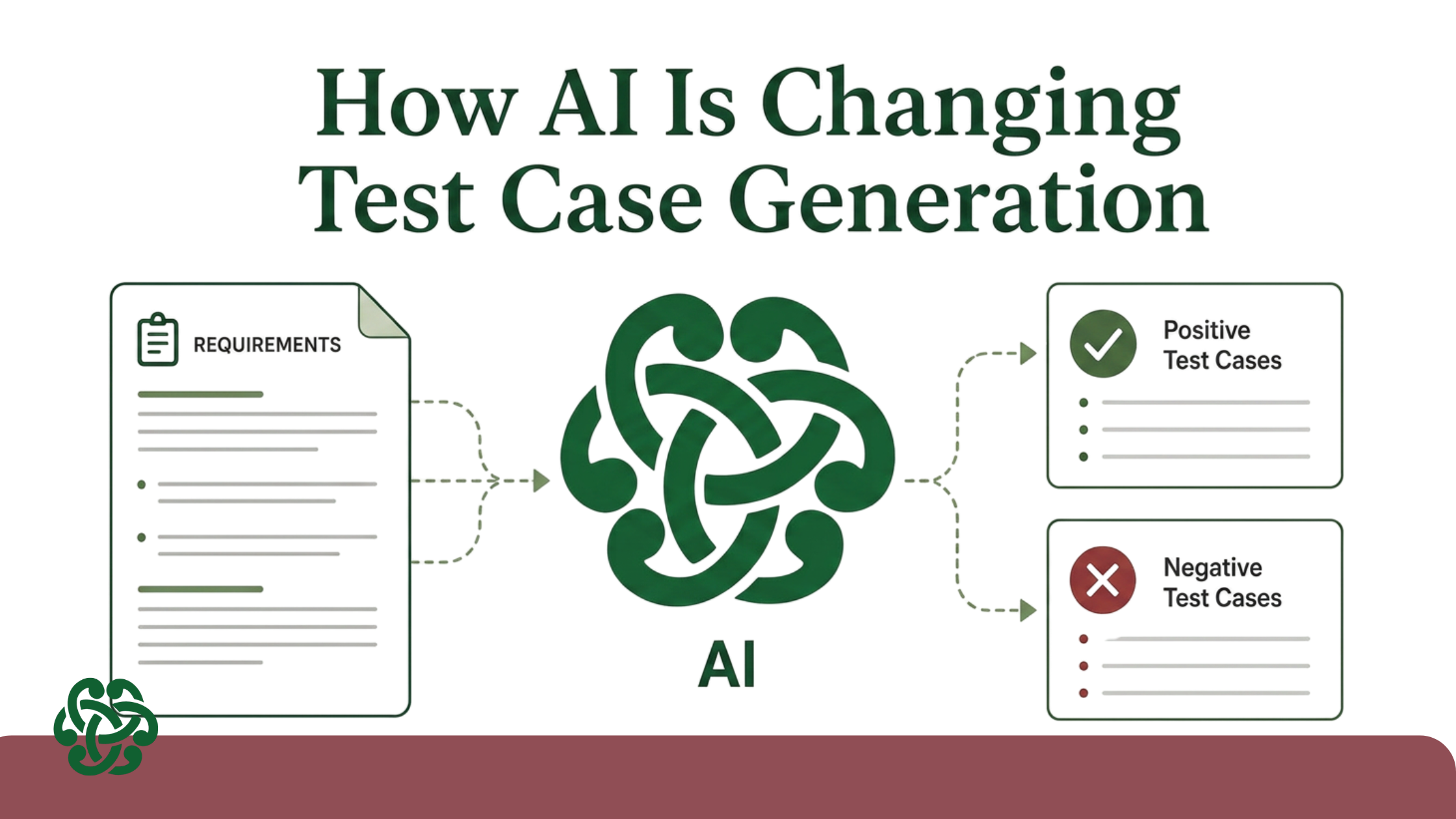
AI test case generation uses machine learning to automatically produce test cases from requirements, user stories, or natural-language prompts, eliminating much of the manual authoring work that slows QA teams down. It doesn’t replace QA judgment; it removes the repetitive, time-consuming parts so engineers can focus on what machines can’t do: context, risk prioritization, and exploratory thinking.
If you’ve ever sat down on a Monday morning with a stack of new requirements and the knowledge that test cases aren’t going to write themselves, this is the part of AI in testing worth paying attention to.
What AI test case generation actually does
At its core, AI test case generation takes an input a requirements document, a user story, a Jira ticket, a plain-language prompt and produces a set of test cases covering the expected behavior. A good implementation generates both positive test cases (does it work when it should?) and negative test cases (does it fail gracefully when it shouldn’t work?).
The result isn’t a finished test suite. It’s a first draft that a QA engineer reviews, trims, and approves but it’s a first draft that would have taken hours to write manually and now takes minutes to generate and review.
TestGen AI, QAConnector’s built-in AI test generation feature, generates both positive and negative test cases from a single requirement document, uploaded file, or written prompt. Teams that previously spent an afternoon on test case authoring are running their first AI-generated suite in under an hour.
The manual test case problem it’s solving
Manual test case authoring has two recurring friction points that AI addresses directly.
The first is waiting. Test cases often can’t be written until someone; a BA, a product owner, an SME produces a clear enough requirement to work from. That creates a bottleneck: QA is blocked, the sprint moves, and testing gets compressed at the end of the cycle.
The second is coverage gaps. Writing test cases manually is mentally taxing, especially for large feature sets. Negative test cases the edge cases, the invalid inputs, the unexpected paths get shortchanged not because engineers don’t know better, but because they run out of time.
AI test case generation addresses both. It works from whatever input exists (even a rough requirements draft), produces a set of cases in minutes, and doesn’t get tired on the negative scenarios. The QA engineer’s job shifts from authoring to reviewing which is a better use of expertise.
How TestGen AI works in QAConnector
The workflow in QAConnector is designed to fit how QA teams already operate, not to replace it with something new to learn.
Three input options:
- Import requirements directly: Connect to Jira or Azure DevOps and pull in the ticket or story.
- Upload a document: Drop in a requirements doc, a spec, or a user-story template.
- Write a prompt: Describe the feature or scenario in plain language and let TestGen AI generate from that.
From any of those inputs, TestGen AI produces a reviewed set of positive and negative test cases, organized and ready to be attached to your test plan. You can accept them as-is, modify individual cases, or regenerate specific scenarios.
The cases created through TestGen AI live inside QAConnector’s unified platform connected to your test plan, your execution workflow, and your reporting. They’re traceable from the moment they’re generated, which matters when Audit-Proof QA is on the line.
What good AI-generated test cases look like
Not all AI test generation outputs are equal. Here’s what distinguishes useful AI-generated test cases from ones that just add noise:
- Clear pass/fail criteria: Each case specifies the expected outcome, not just the action.
- Both positive and negative coverage Both: QAConnector doesn’t mandate a fixed ratio, since it varies by feature, but a common rule of thumb for backend testing is around 80/20 positive-to-negative.
- Traceability to a requirement: Every generated case should link back to the input it came from, so coverage gaps are visible.
- No duplicate logic. Well-tuned generation avoids producing five cases that test the same path with minor variable differences.
- Review-ready, not publish-ready. The best implementations treat generated cases as a draft to approve, not a final artifact. The engineer is the quality gate.
QAConnector’s Test Stack Integration means the cases generated by TestGen AI stay connected to the tools your team already uses Jira, Azure DevOps, Ranorex so nothing lives in a silo.
What AI test generation doesn’t replace
Worth being direct about this, because the “AI will replace QA” narrative does real damage to adoption.
AI test case generation does not replace:
- Exploratory testing: The creative, heuristic work of a skilled tester probing for unexpected failure modes.
- Risk-based test prioritization: Deciding which test cases matter most given the release pressure, the risk surface, and the business context.
- Test review judgment: AI generates a draft. An engineer decides what goes into the suite.
- Session-based testing: Free-form manual exploration of complex user flows that can’t be specified in advance.
What it replaces is the manual, repetitive scaffolding work. The parts that are slow and error-prone. The parts that were making QA the bottleneck.
Why this matters beyond the QA team
For QA practitioners, AI test generation saves hours per sprint. For the engineering leaders who fund QA, the story is about something else: risk reduction and audit readiness.
Every AI-generated test case in QAConnector carries a traceable record — where it came from, when it was created, who reviewed it, whether it passed. That chain of evidence is what Audit-Proof QA means in practice: complete, structured records that can be presented to Internal Audit or compliance teams without a last-minute documentation scramble.
For organizations operating under SOX, NIST, or ISO frameworks, traceability from requirement to test case to result isn’t optional; it’s the audit deliverable. TestGen AI supports this directly: it can generate tests from uploaded non-functional requirements documents, and every generated suite can be exported to Excel for review, giving teams a documented record they can hand to auditors without extra formatting work.
QAConnector is built on Microsoft Azure which means the security and compliance posture behind your test data matches what your security and legal teams expect.
For CTOs and Heads of Quality evaluating QA investment: faster test case generation means more coverage, earlier in the cycle, with less human effort. The defect-escape rate goes down. Release confidence goes up. That’s the business case in two sentences.
The case for getting started now
The QA teams benefiting most from AI test case generation aren’t the ones waiting for the technology to mature; it’s already mature enough to save real time. They’re the ones who started a pilot on a single sprint, saw what the coverage looked like, and expanded from there.
TestGen AI is available inside QAConnector today. If you’re ready to see how it fits your requirements workflow and your stack, schedule a demo and we’ll walk you through it with your use case in mind.
Want to see how your QA strategy should evolve alongside AI tooling? The CelticQA Solutions team explores the strategic view, read their take on AI in QA strategy.
FAQ: The Questions People Actually Ask
What is AI test case generation?
AI test case generation is the use of machine learning to automatically produce test cases from inputs like requirements of documents, user stories, or natural-language prompts. It generates both positive and negative scenarios, giving QA teams a reviewable draft rather than a blank page.
Does AI replace manual test case writing entirely?
No. AI test case generation removes the repetitive authoring work, producing a first draft quickly from requirements. QA engineers still review, refine, and approve the cases before they enter the test suite. Exploratory testing and risk-based judgment remain human activities.
How does TestGen AI in QAConnector differ from generic AI writing tools?
TestGen AI is purpose-built for QA workflows. It generates both positive and negative test cases with pass/fail criteria, links them to requirements for traceability, and integrates directly into QAConnector’s test planning and execution environment so generated cases are immediately usable, not just a text output to copy-paste.
What inputs does TestGen AI accept?
TestGen AI accepts requirements imported directly from Jira or Azure DevOps, uploaded documents (specs, user stories, requirements templates), or plain-language prompts written directly in QAConnector.
How does AI-generated test case traceability work for audits?
Each test case generated by TestGen AI in QAConnector is linked to the requirement or input it came from and carries a full record of who reviewed it, when, and what the execution results were. This complete, structured chain of evidence supports SOX, NIST, and ISO audit requirements without manual documentation work.
Recent Comments