

Test coverage measures how much of your application your tests exercise, but the percentage alone does not indicate quality. Meaningful test coverage maps tests to requirements and risk, not just lines of code, so a high number only matters when it covers the paths most likely to fail in production.
Why Coverage Percentage Isn’t the Whole Story
Most QA teams have lived this moment: the coverage dashboard shows 82%, the sprint report looks clean, and then a customer files a ticket for a bug in a path everyone assumed was tested. The number was real. It just measured the wrong thing.
This is the gap between “we ran a lot of tests” and “we tested what actually matters.” Closing it does not mean chasing a higher percentage. It means changing what the percentage counts. Below is a practical way to measure test coverage that holds up when a release, an auditor, or a CIO asks you to prove it.
What Test Coverage Actually Measures
Test coverage is the proportion of your application, measured in code, requirements, or functionality, exercised by your test suite, and it only becomes a meaningful signal once it is weighted by the risk of what is left untested.
Three coverage types get used interchangeably, and that’s where confusion starts:
– Line/statement coverage counts which lines of code executed during a test run. It says nothing about whether the test asserted anything useful.
– Branch coverage counts which conditional paths (if/else, switch cases) ran. Better than line coverage, still blind to whether the assertions were meaningful.
– Requirements (traceability) coverage counts which documented requirements have at least one test verifying them, whether the underlying code exists yet.
Most coverage dashboards report the first two because they’re cheap to instrument. The third is the one that maps to what a business needs to trust: did we test what we said we would build.
Why the Coverage Percentage Alone Misleads Teams
A high coverage percentage can hide three specific problems:
- Tests that execute code but assert nothing. A test that calls a function and checks nothing about the result still counts toward line coverage.
- Coverage without risk weighting. A payment processing function and a footer link get equal credit in most coverage tools, even though a defect in one cost vastly more than a defect in the other.
- Coverage that decays silently. Code changes; tests that once covered a path can go stale without anyone noticing until the next incident.
We disagree with the common advice to set a coverage percentage target and hold teams to it. The number is a proxy, and proxies get gamed, intentionally or not. The better question is narrower: are the tests that would have caught your last three production defects running today?
How to Measure Test Coverage That Actually Reduces Risk
- Map tests to requirements, not just code. Every requirement or user story should have at least one test case tied to it in your test management system, so coverage reads as “requirements verified” rather than “lines executed.”
- Weight coverage by production risk. Rank functionality by business impact and defect history, then track coverage separately for your top risk tier. A payment flow at 95% matters more than an admin settings page at 95%.
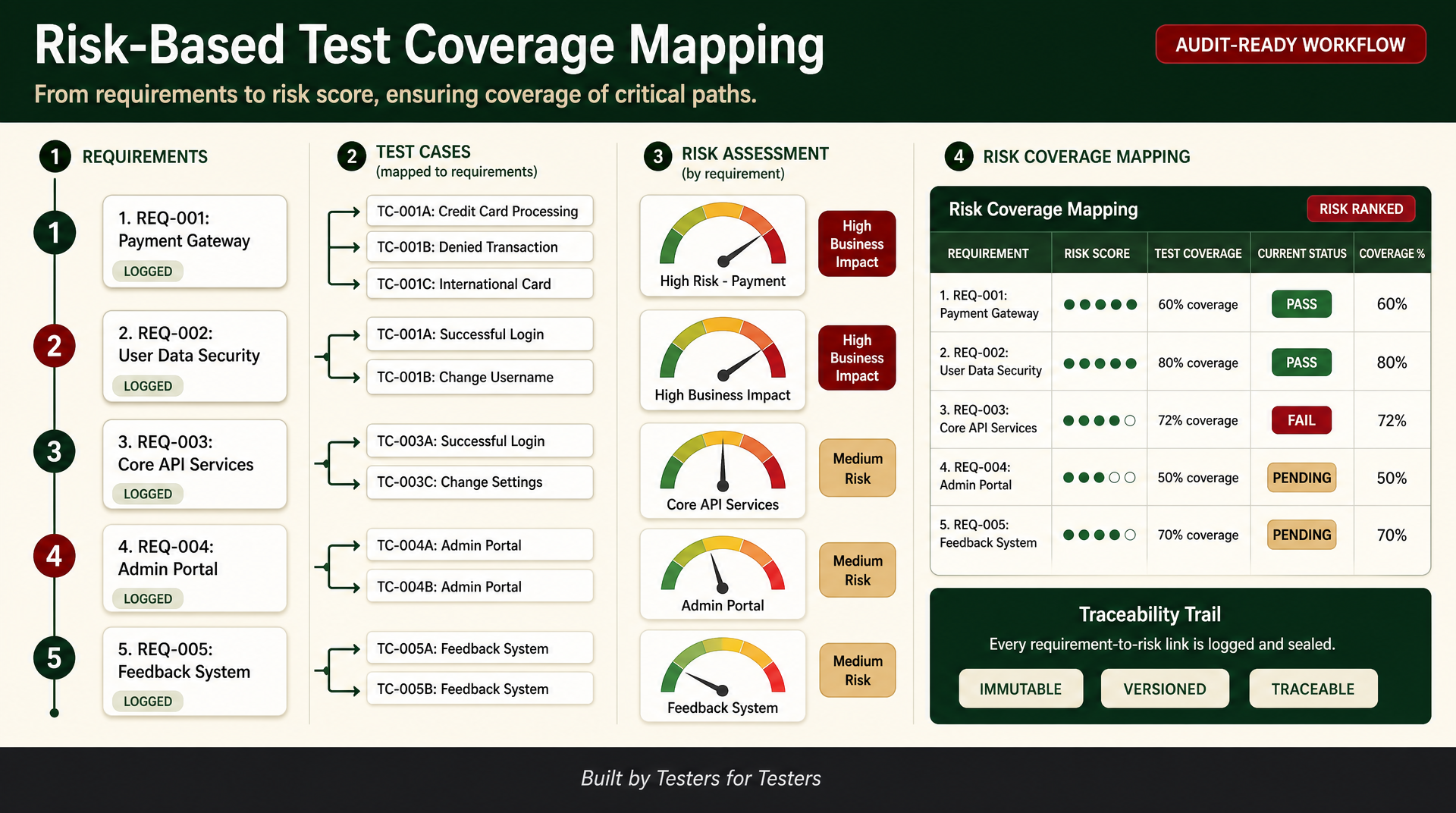
- Track coverage decay, not just coverage snapshots. Re-run traceability reports every sprint, not just before a release, so gaps surface while they’re cheap to fix.
- Set a release gate on traceable coverage, not raw percentage. Block a release when a high-risk requirement has zero passing tests tied to it, not when overall coverage dips below an arbitrary number.
What Auditors and CIOs Actually Check For in Test Coverage
For a QA manager, coverage is a sprint health signal. For a CIO or an auditor reviewing SOX, NIST, or ISO controls, it’s evidence. Those are different questions, and a coverage percentage answers neither well on its own.
|
What a coverage percentage shows |
What traceable coverage shows |
|
A number, no context |
Which requirement each test verifies |
|
Same weight for every function |
Risk weighted by business impact |
|
A point-in-time snapshot |
A history you can audit after the fact |
|
“We tested a lot” |
“Here is proof we tested the right things” |
This is the audit-readiness gap QA management platforms are increasingly asked to close: complete, structured, traceable records that demonstrate compliance with confidence. Frameworks like ISO/IEC 42001 and the NIST AI Risk Management Framework are pushing this same shift, from “we did the work” to “we can show our work,” into how AI-assisted testing gets governed too.
How TestGen AI Closes the Coverage Gap
TestGen AI generates positive and negative test cases directly from a requirement document, which changes where coverage gaps usually come from. Manually authored suites tend to skip negative paths (what should NOT happen) because they take longer to write and are easy to deprioritize under sprint pressure. TestGen AI generates both in minutes, so requirements coverage doesn’t depend on whether someone had time to write the edge case.
Paired with Real-Time Reporting, that traceability shows up as a live view rather than a spreadsheet assembled the week before an audit. Audit-Proof QA in QAConnector keeps that trail intact automatically, and Test Stack Integration with Jira, Azure DevOps, and Ranorex means the requirement, the test, and the result live in one connected view instead of three disconnected tools.
FAQ:
Is 80% test coverage good enough?
There’s no universal good number. 80% requirements coverage on your highest-risk functionality is worth more than 95% line coverage spread evenly across low-risk code. Judge coverage by what it verifies, not the percentage alone.
What is the difference between code coverage and test coverage?
Code coverage measures which lines or branches executed during a test run. Test coverage is the broader term, and can also measure which requirements or user-facing functionality have been verified, whether or not that maps cleanly to a specific line of code.
How do auditors verify test coverage?
Auditors typically ask for a traceability matrix connecting requirements to test cases to results, not a coverage percentage.
What is risk-based test coverage?
Risk-based test coverage means weighting your coverage targets by the business impact and defect history of each area of the application, so high-risk functionality gets deeper testing than low-risk functionality.
Does 100% test coverage mean no bugs will ship?
No. 100% coverage only confirms every line or branch executed during testing, not that every meaningful scenario or edge case was tested with a correct assertion. Teams have shipped release-blocking defects from code with 100% line coverage.
How does TestGen AI improve test coverage?
TestGen AI generates positive and negative test cases directly from requirement documents, which closes the common gap where negative and edge-case testing gets skipped under time pressure.
Conclusion
Coverage percentage is not the goal. It’s one input into a harder question: can you show, with evidence, that the tests you’re relying on actually cover what matters to the business and to whoever is asking you to prove it. Start by mapping your top-risk requirements to test cases this sprint, not your whole backlog.
See how QAConnector traces every requirement to a test case and a result, automatically. Schedule a demo to see it against your own test stack.
Recent Comments