
AI-generated API tests exists because manual API testing is great at exactly one thing: confirming your API works as documented, under ideal conditions, with cooperative clients, on a good day.
Production, unfortunately, does not care about your good day.
These failures are not mysterious: idempotency under retries, schema drift, pagination edge cases, race conditions, rate-limit mismatches, and webhook delivery chaos. They are just too tedious to author at scale. So they do not get authored. And then they become incidents.
TestGen AI generates those scenarios automatically from your OpenAPI spec or requirements doc, and Audit-Proof QA makes every result defensible. Here is how.
Watch a 2-minute walkthrough of TestGen AI for APIs →
The API Coverage Gap Nobody Wants to Admit
Every API test programme has the same shape: solid happy-path coverage, some contract validation, maybe a smoke suite that runs on deploy. Excellent. Gold star.
What it does not have is coverage of the edges that actually cause production failures. For the CelticQA-side view of which failures matter most, see the companion piece on Common API Failure Points QA Teams Miss, built for engineering leaders auditing their programmes.
- Idempotency under retries. What happens when a client retries a POST because they did not hear back? Do you process it twice? Most teams test idempotency on one or two endpoints. TestGen AI covers every POST.
- Schema drift. Your API returns a 200. The response body has quietly changed. Your contract tests pass because nobody updated the spec. Drift is not dramatic. It is just a slow leak.
- Pagination at the boundaries. Empty pages. Boundary pages. Cursors that expire mid-session. Total-count mismatches. Each paginated endpoint is a matrix of scenarios that nobody wants to write by hand.
- Concurrent writes on shared resources. Two requests, one resource, a race you did not plan for. Conflict resolution logic is only as good as the tests that actually stress it.
- Rate-limit and retry mismatches. The client backs off. The server’s window resets on a different schedule. Sustained-load scenarios surface these interactions before your users do.
- Webhook delivery failures. Invalid signatures. Replayed payloads. Out-of-order delivery. Dead-letter behavior. The async failure modes that are completely invisible until they are not.
Multiply each of these across an API surface of hundreds of endpoints and manual authoring is not a strategy. At this scale, it is a hope.
What AI-Generated API Tests Does That Manual Testing Cannot
AI-generated API testing through TestGen AI, the test-case-generation engine inside QAConnector, starts with an OpenAPI spec, a Postman collection, a requirements doc, or a handful of example payloads. It does the rest:
- Generates positive scenarios: happy paths, expected ranges, valid auth flows.
- Generates negative and adversarial scenarios: malformed payloads, oversized inputs, boundary values, type-coercion edge cases, and prompt-injection patterns from the OWASP API Security Top 10.
- Tags every case against both the endpoint and the failure mode, so you get traditional coverage reporting and risk-based coverage reporting, not just “tests passed.”
- Outputs structured test cases, each a stored object with request payload, expected behavior band, version metadata, and reviewer assignment.
Teams running this workflow typically cut manual test authoring effort by up to 80%. The savings are biggest in the first round, when the edge-case surface is widest and hand-authoring feels most hopeless.
The Audit Trail You Build as You Go
Here is the part that matters for regulated industries: Audit-Proof QA does not produce a report you scramble to assemble when the auditor emails. It produces a structure that exists the moment a test runs.
Every API test captures the endpoint, the request payload, the API version, the response, the expected behaviour band, the reviewer, the timestamp, and the decision: pass, fail, or override with rationale. Immutable. Versioned.
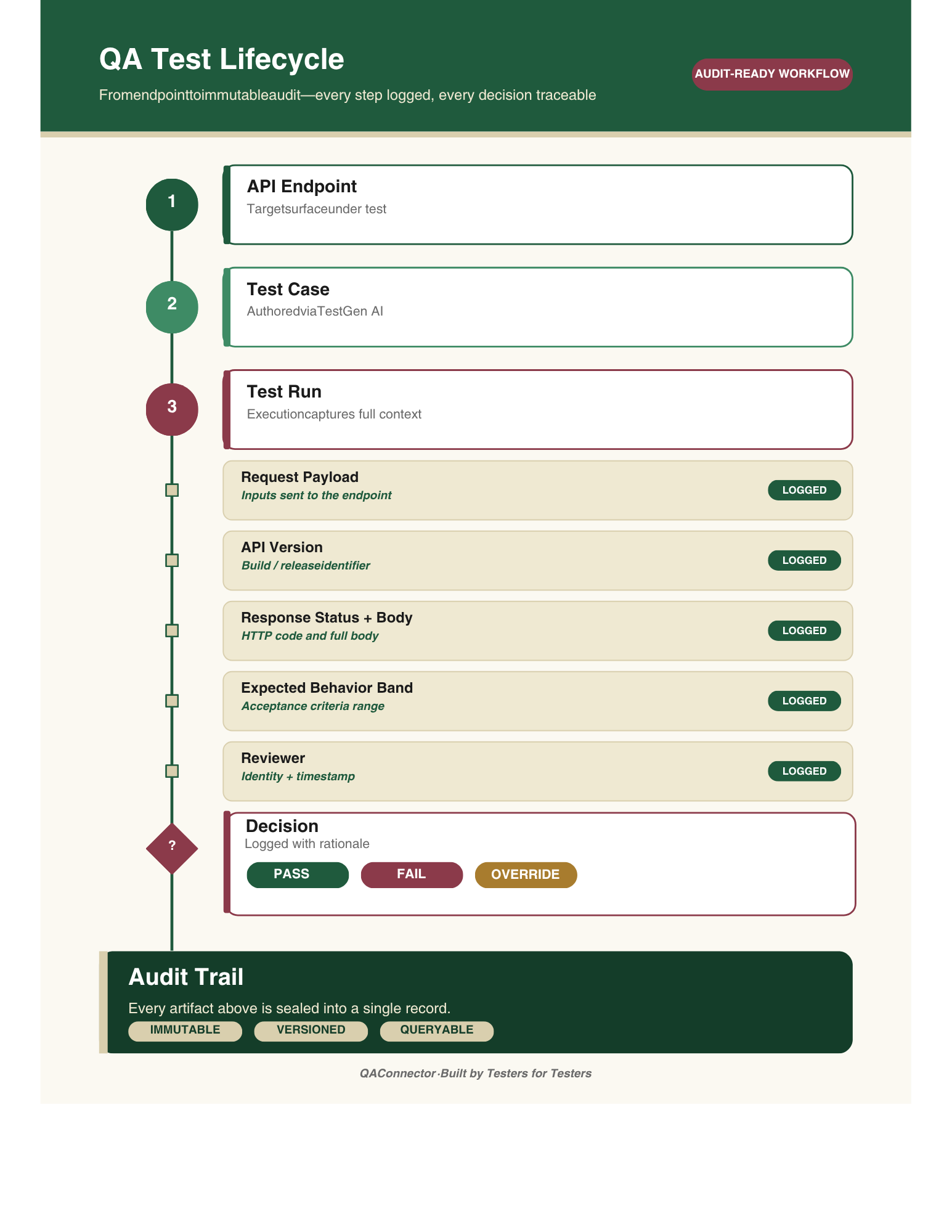
When someone asks “show me how this API behaves under retry,” the answer is a query. Not a recovery operation. Not a very stressful afternoon.
For financial services, healthcare, and payments teams, where “we tested it” and “we can prove it” need to be the same sentence, this gap matters more than almost anything else in the test program.
Built on Azure, Because Boring Infrastructure Is Good Infrastructure
QAConnector runs on Microsoft Azure. API test data, including request payloads, response bodies, and reviewer decisions, all of which can contain genuinely sensitive material, sits inside Azure’s encryption, RBAC, region-aware storage, and compliance posture (SOC 2, ISO 27001, FedRAMP, and more depending on your region and contract). The goal is that you show up to a vendor security review without surprises. Azure makes that possible. You’re welcome.
FAQ: The Questions People Actually Ask
What is AI-generated API testing?
An AI model produces test cases from your spec automatically: positive scenarios, negative inputs, adversarial cases. It covers the edges that manual authoring skips, not because your team is lazy, but because there are simply too many of them.
Can TestGen AI generate idempotency tests?
Yes. Same-request retry sequences, idempotency-key validation, time-out-induced retries: generated by default, with exactly-once semantics as the assertion and full request-response context in the audit log.
How does it handle schema drift?
Every generated test validates the response against the versioned OpenAPI contract on every run. When the response diverges (added fields, changed types, removed properties), the test fails with a structured diff. Drift becomes a defect with a paper trail, not a 200-passing surprise you discover in production.
What is the difference between contract testing and what TestGen AI generates?
Contract testing confirms your API matches its spec. TestGen AI generates the integration tests around that spec: the retries, the concurrency, the pagination edges. Both matter. TestGen AI handles half that is currently a coverage gap.
Can QAConnector test third-party APIs?
Yes. TestGen AI is endpoint-agnostic. For APIs you do not control, generated tests focus on consumer-side validation: response handling, retry logic, schema enforcement. You cannot control what the provider does. You can control how well your code handles it.
The Bottom Line
Manual test authoring covers the contract surface. TestGen AI covers the risk surface: the scenarios that are too numerous to write by hand and too important to skip. Audit-Proof QA makes every result defensible.
If you are building an API test program that needs to hold up under load, under audit, and under the general weight of time, this is what coverage actually looks like.
Schedule a QAConnector demo → We will generate API edge case tests from your OpenAPI spec in 25 minutes. Bring the specs. We will bring the edge cases.

Siobhan MCGrath
A certified QA Lead with almost a decade of experience across insurance, e-commerce, engineering, and ERP/CRM platforms. From solo builds to full team delivery, the work spans every phase of the project lifecycle and every type of application complexity that comes with it.
Recent Comments